
Off Flavors in Your Beer-Detection, Identification and Prevention

Troubleshooting the off flavors in your home brewed beer is an art as well as a science. With a little experience and a good reference, you will learn to refine your sanitization and brewing practices to prevent these unwanted flavors.
Although processes and sanitization are often the cause, there are many subtle causes that must be taken into consideration once you have eliminated the obvious. Many are extremely nasty once they get into your brewery so detection and and identification are important. Once identified, learn how to eliminate them immediately.
Once you learn to evaluate your beer, you’ll begin to notice aromas and flavors you never noticed before. Some common off flavors are acceptable in certain styles, ie. diacetyl is acceptable in Scottish ales, but not in most lagers or other clean beers.

To further fine tune your abilities to detect off flavors in beer, just about everyone will benefit from sensory training. Breweries, and those involved in beer judging and beer serving like BJCP Judges (Beer Judge Certification Program) or a Beer Cicerone, use professionally-designed sensory panel training techniques to improve taster accuracy. By using pure food-grade flavor and aroma compounds added to samples of reference beer, tasters learn to separate the hundreds of beer off flavors into individual recognizable traits, giving the taster valuable knowledge about desirable and undesirable characteristics in the beverage. I highly recommend these BrewEssence™ Beer Off Flavor & Sensory Training Kits from MoreBeer.com.
Listed below are links for troubleshooting most of the common off flavors you may encounter when homebrewing.
Under each category of off flavor in your beer, we will discuss causes and prevention so you can eliminate them the next time you brew.
Troubleshooting the Common
Off-Flavors in Beer
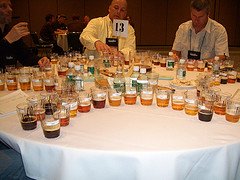
Good Sensory Pracitces
Before you begin evaluating your beer for common off flavors, here are some Good Sensory Practices- Do’s and Don’ts from the Flavoractiv™ website (edited for homebrewers):
Do:
- Be fragrance neutral
- Participate regularly (practice often)
- Take time and focus on the evaluation
- Follow methods and instructions precisely (see image below)
- Rest and cleanse your palate
Don’t:
- Eat, drink or smoke 30 minutes before the evaluation session
- Use gum or mints 30 minutes before the evaluation session
- Wear perfume, cologne or fragrance
- Evaluate the sample if you have lots of prior knowledge about the product ie. (preconceived perception of how it will and should taste)
- Taste the sample if you have a cold
These “good sensory habits” are intended for judging in competitions, or for those who do sensory analysis of beers or other beverages for a living…but they also apply to evaluating your own homebrew for off flavors. You can find several good senory kits online, just search for “beer sensory kit”…

Common Off-Flavors in Beer
ACETALDEHYDE IN BEER is perceived as green apples in both aromas and flavors. Although it is noticed in a few commercial examples, for the most part it is considered a flaw. To learn more about what causes ACETALDEHYDE IN BEER and how to prevent it, click here.
DMS IN BEER- Dimethyl Sulfide is a volatile sulfur based compound which if noticed, will be perceived as cooked can corn, or possibly celery. To learn how DMS in beer is produced and the easiest fix, click here.
SKUNKED-or LIGHT STRUCK beer is a fault caused by the reaction of isomerized alpha acids from hops (isohumulone) with riboflavin in the presence of light. To learn about how to prevent this unwanted flavor, click here.
METALLIC off flavors are perceived as the taste of a rusty nail, or coin-like, tinny and blood-like. To see some of the causes and preventions of metallic flavors in your beer, click here.
OXIDIZED or STALE flavors in beer are perceived as sherry-like, stale bread, wet cardboard and paper. It is not always considered a fault though. To find out more about stale flavors in your beer, click here.
SOUR or ACETIC flavors are perceived as sour, vinegar-like, and tart on the sides of your tongue. The primary causes of sourness in beers are bacterial. To learn how to prevent these sour flavors, click here.
VEGETAL flavors in beer often manifest themselves as cooked cabbage, broccoli, or corn. To learn about the causes and prevention of vegetal flavors and aromas in your beer, click here.
ALCOHOL FLAVORS IN BEER are usually caused by fermenting at too high of a temperature which causes the yeast to produce too many fusel alcohol flavors. These are perceived as being hot and spicy. To learn more about alcohol flavors in beer, click here.
ESTERS IN BEER For some beers, such as German hefeweizens, fruity esters define the style. But for other beers, like clean lagers, ester formation is not wanted and is considered a flaw. You as the brewer have some control of the amount and type of esters in your beer. To learn all about esters in beer, and some ways you can control their production, click here.
PHENOLIC FLAVORS IN BEER are most often described as clovey, spicey, smokey, band-aid-like, or medicinal. Except in a few beer styles where some of these flavors are considered appropriate, these compounds are for the most part considered a flaw. To find out what can cause phenolic flavors in beer and how to prevent them, click here.
FATTY ACIDS IN BEER usually start with low concentrations in wort initially but increase as fermentation and maturation progresses. These medium-chain acids are a normal constituent of your beer. They contribute to the characteristic flavors you associate with some beers. To learn about the fatty acids in beer that can cause off flavors, click here.
DIACETYL IN BEER is a normal byproduct in the fermentation process. There are varying methods of reducing or eliminating it in the final product, but it is always produced. To learn all about diacetyl in beer, how to detect it and prevent it, click here.
BEER ASTRINGENCY Astringency is perceived as a dry grainy, mouth-puckering, tannic sensation (think of sucking on a wet tea-bag). Although astringent flavors may be caused by bacterial contamination, it is usually the result of processing. To learn more about beer astringency, click here.
Sulfur Odors in beer are most often produced by lager yeast but some ale yeast will produce sulfur odors as well. These usually occur about 3 days into the fermentation. Sulfur odors in beer can only escape from the beer by diffusion into the atmosphere. Learn more about this off flavor.
Learning how to identify common off-flavors in beer can be frustrating, but learning the causes and cures will help you brew better beer next time.
It happens to the best brewers, that’s how they get to be the best brewers, by learning from their mistakes.
Purchase your measuring & testing equipment for your home brewery at MoreBeer.com
Go Back to Brewing Science
Go Back to the Evaluating Beer Page
